

“We need to talk.” Four words, one dropped stomach. For a lot of couples, communication has turned into a minefield of unspoken resentments, one-word texts, and sighs that say more than sentences do. At the heart of it is a simple truth: most communication issues in relationships come down to fear, discomfort, or simply not knowing how to say the hard thing out loud.
If you’ve ever been ghosted mid-argument or frozen out with the silent treatment, you already know how much damage silence can do. And if you’ve caught yourself Googling “are we okay?” at 11 p.m., you’re not alone either. This is more common than people think, and it doesn’t always look like constant fighting. Sometimes it looks like two people who’ve quietly stopped really talking to each other at all.
Core Therapy’s Founder & CEO, Damian Robledo, MSW, LCSW, hears some version of this question from clients all the time. He often encourages people to start with a few simple ones of their own:
“Ask yourself — can you be honest? Can you disagree safely? Do you feel like you? If you’re always anxious or walking on eggshells, that matters. And the fact you’re asking tells me something already feels off.”
— Damian Robledo, MSW, LCSW, Founder & CEO, Core Therapy
Stop walking on eggshells and start talking with confidence — schedule a session today with Core Therapy.
Key Takeaways
Communication breakdowns like the silent treatment and ghosting are rarely about the surface-level fight. They’re usually a sign of deeper fear, unspoken needs, or old wounds, and they’re one of the most common, and most treatable, reasons couples come to therapy.
- The silent treatment and ghosting look similar but differ in intent, duration, and relationship context.
- Recurring arguments, emotional distance, and “walking on eggshells” are all signs worth paying attention to.
- Communication problems are rarely about logistics — they’re about unmet emotional needs underneath.
- Couples therapy (and even individual therapy) can shift these patterns, even if only one partner starts.
- Questioning your relationship doesn’t mean it’s failing. It usually means you care about it.
The Silent Treatment: AKA the “I’m Not Mad, I’m Just Not Speaking to You” Phase
There’s nothing quite like the power of saying nothing. The silent treatment, sometimes only half-jokingly called “emotional ghosting,” is a classic, if unhealthy, communication strategy where one partner withdraws entirely during conflict. According to psychologist Kia-Rai Prewitt, PhD, of Cleveland Clinic, it’s the act of withholding communication — a common stonewalling behavior that can be intentional or unintentional. For some people it’s a coping mechanism; for others, it’s a way of causing harm. It is not an effective way of setting a boundary.
Why It Happens
- Avoidance of confrontation. Many people weren’t taught healthy conflict resolution growing up. Silence feels safer than potentially saying the wrong thing.
- Desire for control. Withdrawing can be a way of regaining power when someone feels hurt or unheard.
- Emotional shutdown. Overwhelmed partners may go quiet as a defense mechanism, what researchers call “emotional flooding,” where the nervous system reacts as though a social bond is under threat.
Why It Doesn’t Work
While the intention might be to protect oneself or cool off, the result is usually confusion, hurt, and a slow breakdown of trust. When one partner stops talking, the other is left to fill in the blanks, and that rarely ends well. (Spoiler: “they’re definitely just thinking about what they did” is usually a myth.)
One important note: the silent treatment isn’t automatically abuse. Intent matters. If it’s being used to control or punish, and to place the blame back on you, that crosses a line, and if that sounds familiar, the National Domestic Violence Hotline (1-800-799-7233) is a free, confidential resource available 24/7. If it’s coming from someone who’s overwhelmed and doesn’t yet have the skills to communicate under stress, that’s something couples therapy can help address directly.
Ghosting: Not Just for Dating Apps Anymore
Ghosting, cutting off all communication without explanation, has made its way from swiping left to long-term relationships. When feelings go uncommunicated, unresolved conflict can build up until it erupts as a full withdrawal. Whether it’s walking out mid-fight or slowly disappearing emotionally, ghosting in a committed relationship is a red flag worth naming.
Cleveland Clinic psychologist Susan Albers, PsyD points to a few common threads behind why people do it: they don’t know how to handle conflict, they don’t want to be the one who causes hurt feelings, they lean passive-aggressive under stress, or they carry an insecure attachment style that makes closeness feel unsafe.
Why Ghosting Hurts So Much
- It denies closure. Being left without an explanation makes it hard to process what went wrong.
- It triggers abandonment wounds. For many, ghosting activates deep emotional pain from earlier in life.
- It avoids vulnerability. Walking away is easier than facing a hard conversation, but it comes at a high emotional cost.
If you’ve noticed yourself wanting to disappear the moment things start to feel close, it’s worth understanding why walking away can feel safer than staying and talking — it’s a more common instinct than people realize.
Silent Treatment vs. Ghosting: What’s the Real Difference?
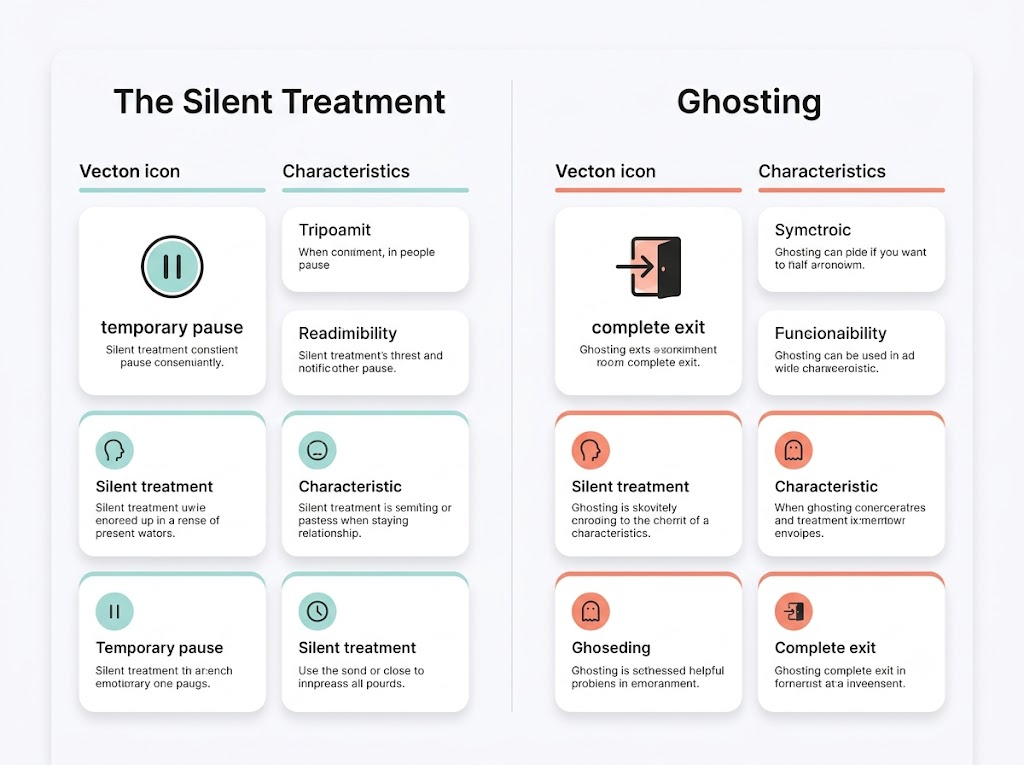
They get lumped together, and it’s easy to see why. Both involve someone going quiet when you need them to talk. But they’re not the same behavior, and the difference matters for how you respond.
| Aspect | The Silent Treatment | Ghosting |
| Primary intent | To punish, regain control, or self-protect during conflict | To avoid a hard conversation entirely, often to end things |
| Typical timing | Mid-conflict or right after a disagreement | Can happen anytime — often with no argument first |
| Duration | Temporary — hours to weeks, usually followed by re-engagement | Often permanent, with no explanation or return |
| Relationship stage | Usually happens within an established relationship | Can happen at any stage, from early dating to long-term partnerships |
| What it signals | Discomfort with confrontation, or a bid for power in the moment | Avoidance of the relationship itself, or discomfort with vulnerability |
Both fall under what therapists call negative communication patterns, and both leave the other person to fill in painful blanks on their own.
9 Signs Your Relationship Could Use Communication Support
Some couples fight constantly. Others barely fight at all and still feel miles apart. Both can point to the same underlying problem. Here’s what that tends to look like in real life:
- You keep having the same argument. If you and your partner are stuck in a loop, it’s rarely about the dishes. It’s about something underneath that hasn’t actually been resolved.
- The silent treatment or ghosting shows up during conflict. Withdrawal has become the default response instead of working through it.
- You avoid the “real” topics. Money, intimacy, and the future get quietly skipped because they feel too risky to bring up.
- Passive-aggressive comments replace direct ones. “I’m fine” when you’re 100% not fine.
- You feel distant, even when you’re together. Your partner starts to feel more like a roommate than a partner.
- Small comments turn into big misunderstandings. A mismatch in communication styles can turn minor moments into major conflict.
- You’re keeping score. “I did the dishes three times this week — what did you do?”
- You’re not sure how to fix it. The problems feel too tangled to untangle on your own.
- You’re constantly asking, “are we okay?” From the outside, everything might look fine. Internally, something feels off, and that gap is worth paying attention to.
The problem isn’t that any one of these happens once. It’s when they become the norm, which is usually when small friction turns into real distance. If a handful of these sound familiar, that’s reason enough to take a closer look at whether your relationship needs support — you don’t have to wait for a bigger breaking point.
Recognizing a few of these in your own relationship? Let’s talk it through — a free consultation is a low-pressure place to start.
What’s Actually Going On Underneath
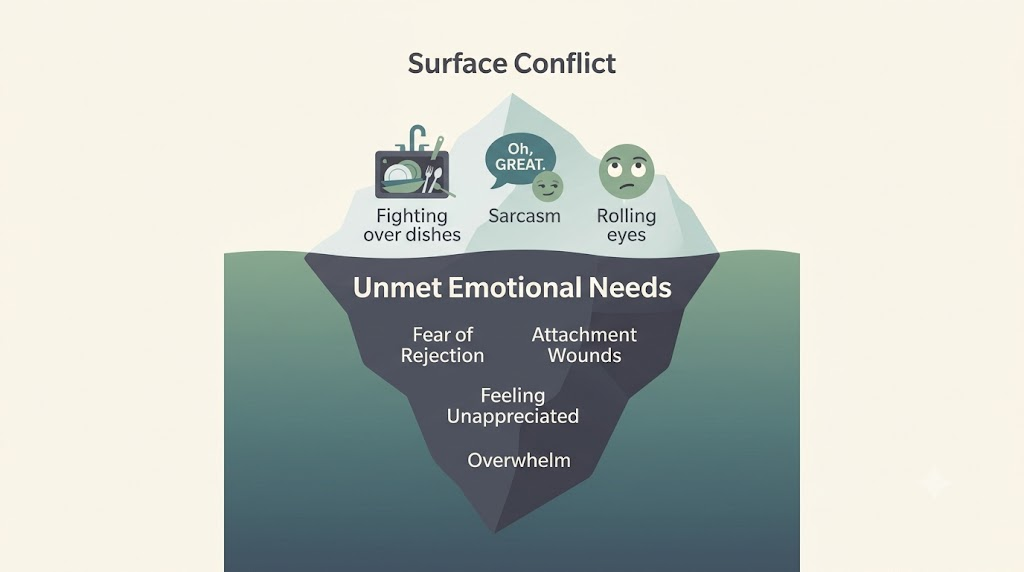
A lot of couples think they have a “communication problem” because they fight too much. Here’s the twist: conflict isn’t the issue. It’s how you handle it. Poor communication is rarely about logistics (“you didn’t take out the trash”) and almost always about emotion (“I feel unappreciated”). Instead of saying that directly, people fall into old patterns — silence, sarcasm, walking away — because vulnerability is hard, and because naming what you’re actually feeling in the moment is its own skill that a lot of us were never taught.
Underneath the surface, many communication issues trace back to attachment wounds, fear of rejection, or past trauma. And in longer relationships, it doesn’t always take a wound to create distance. Sometimes it’s just life. Daily stress, work, parenting, and the general grind can quietly push emotional connection to the background until couples are coexisting more than connecting. That doesn’t mean the relationship is broken. It usually means it needs some intentional attention and a few new tools.
As Damian puts it:
“This work isn’t just professional, it’s personal. I know what it feels like to be stuck, to feel unseen, or unsure of where to turn.”
— Damian Robledo, MSW, LCSW, Founder & CEO, Core Therapy
How Couples Therapy Can Help (No, It’s Not Just for Failing Relationships)
Couples therapy has come a long way from the stereotype of tense couches and “how does that make you feel?” Think of it more like a communication boot camp, with empathy. Here’s how it actually works:
- Creates a safe environment. A neutral therapist can mediate tough conversations so both people feel heard without escalating into “you always…” territory.
- Teaches emotional regulation. Before we can speak honestly, we need to manage our own emotions. Therapy helps identify triggers and build calming strategies, so you can respond instead of react.
- Builds empathy and listening skills. Approaches like Emotionally Focused Therapy, Imago Relationship Therapy, and Integrative Behavioral Couple Therapy are all built around helping partners actually hear each other, not just wait for their turn to talk.
- Uncovers the real issues. That fight about dishes? Probably about feeling unsupported. A therapist helps surface the deeper need underneath the surface-level argument.
- Offers communication frameworks. Tools like “I” statements, repair attempts, and structured conflict dialogues give couples a roadmap for hard conversations, so there’s less guesswork involved.
Curious what that actually looks like session to session? Here’s how couples therapy works, and why it’s not reserved for relationships in crisis.
But What If My Partner Doesn’t Want to Go?
Here’s the good news: it only takes one person to shift a dynamic. While couples therapy works best with both partners present, individual therapy can lead to real breakthroughs on its own. When one person starts communicating differently, more openly, more calmly, the whole relationship often starts to shift in response.
So, start the conversation. Suggest therapy gently, not as an ultimatum. You’re not saying the relationship is broken. You’re saying it’s worth investing in.
Practical Tips You Can Use Today
Not ready for therapy yet? Here’s where to start:
- Use “I” statements. “I feel overwhelmed when…” instead of “you never…”
- Take a real time-out, not a silent one. Say, “I need 20 minutes to cool down,” and then actually come back. If setting that kind of boundary feels uncomfortable, you’re not alone. It’s a skill like any other.
- Schedule regular check-ins. Short, low-stakes conversations about feelings and stress prevent small frustrations from stacking up.
- Practice active listening. Reflect back what you hear: “so you’re feeling ignored when I work late?”
- Lead with curiosity, not blame. Approaching a hard topic with curiosity instead of criticism helps your partner feel safe enough to open up.
- Pause when emotions run high. A few slow breaths before responding can keep a conversation from escalating.
- Pay attention beyond words. Eye contact, tone, and body language communicate as much as anything you say out loud.
- Compromise and get on the same page. Work together toward solutions that meet both of your needs, not just one.
Questioning Your Relationship Isn’t a Bad Sign
Many people assume that questioning their relationship means something is wrong. In reality, reflection usually means you care about its health. Recognizing communication issues, emotional distance, or a recurring conflict is often the first real step toward a stronger connection, not proof that things are falling apart.
Real relationships aren’t like TV. There’s no laugh track to soften an awkward silence, no dramatic fade-to-black after a slammed door. Ghosting and the silent treatment might feel like shortcuts around conflict, but they only lead to more distance. At the heart of every healthy relationship is a willingness to stay in the conversation, even when it’s hard. That’s where therapy comes in: not to point fingers, but to hold up a mirror, hand you some tools, and help two people talk like they actually like each other again.
Frequently Asked Questions
What’s the difference between the silent treatment and ghosting?
The silent treatment is a temporary withdrawal used during conflict within an existing relationship, often to punish, regain control, or self-protect. Ghosting is a more complete and often permanent disappearance, sometimes with no preceding conflict at all, usually meant to avoid a hard conversation entirely.
Is the silent treatment a form of abuse?
Not always. Intent is what matters most. If someone uses silence to control or punish you and insists it’s your fault, that’s abusive. If it comes from someone who’s emotionally overwhelmed and lacks better tools, it’s unhealthy but not necessarily abuse. Either way, it’s a sign something needs to change.
What are the signs of healthy communication in a relationship?
Healthy communication looks like both partners feeling safe to disagree, listening without immediately defending, expressing needs directly instead of through silence or sarcasm, and repairing conflict instead of avoiding it.
How do I know if my relationship needs couples therapy?
If you’re stuck in repeat arguments, avoiding real topics, feeling distant, or simply unsure how to fix what feels off, that’s enough reason to reach out. You don’t have to wait for a crisis to get support.
Can a relationship survive bad communication?
Yes. Communication is a learnable skill, not a fixed trait. With the right support, most couples can rebuild trust and reconnect, even after long stretches of silence, avoidance, or misunderstanding.
Need support navigating communication issues in your relationship? Core Therapy offers couples counseling designed to help you reconnect, communicate, and heal together — 100% virtual across California. Contact us today to start the conversation that could change everything.
About the Author
Written by Core Therapy. Core Therapy is a 100% virtual therapy practice licensed statewide in California, offering individual, couples, and family therapy for anxiety, depression, trauma, grief, ADHD, and relationship communication issues. Founded in May 2022 in response to the pandemic-era surge in isolation and anxiety, the practice partners with the USC Master of Social Work program to keep quality care accessible, including free and sliding-scale sessions with supervised graduate interns.
About the Clinical Reviewer
Clinically reviewed by Damian Robledo, MSW, LCSW, Founder & CEO of Core Therapy. Damian launched Core Therapy to make virtual, statewide care in California more human and more accessible. As he puts it, this work “isn’t just professional, it’s personal. I know what it feels like to be stuck, to feel unseen, or unsure of where to turn.”
Disclaimer: This article is for informational purposes only and isn’t a substitute for professional diagnosis or treatment. If the silent treatment or withdrawal in your relationship is part of a larger pattern of abuse, the National Domestic Violence Hotline (1-800-799-7233) is available 24/7, free and confidential.