

Key Takeaways
- The short answer: For most adults with anxiety or depression, therapy by live video works about as well as therapy in an office. Studies that compare the two find little to no difference in symptom relief, in how many people drop out, or in how connected clients feel to their therapist.
- Where the evidence is strongest: Cognitive behavioral therapy (CBT), delivered by video or through therapist-guided online programs.
- California specifics: Your therapist needs a California license, and you need to be physically in California during the session. Expect an informed consent conversation and a plan for emergencies.
- Who it’s not for: If you’re in crisis or unsafe at home, online sessions alone may not be enough. Call or text 988 any time.
Already convinced and just want to talk to someone? Schedule a free consultation →
Let’s start with the question you probably typed into a search bar at 11 p.m.: Is this actually going to work, or am I about to spend money talking to a screen?
It’s a fair thing to wonder. Anxiety and depression are hard enough without also wondering whether the format of your care is a downgrade. (Spoiler: for most people, it isn’t.) Here’s what the research says, what’s different for California clients, and where online therapy honestly falls short.
So, is online therapy effective for anxiety and depression?
Yes, for most adults. Studies comparing live video therapy with in-person therapy find similar symptom relief for depression and anxiety, and similar dropout rates. The format matters far less than the quality of the therapy and how well you click with your therapist. Crisis and unsafe home environments are the main exceptions.
What does the research actually say?
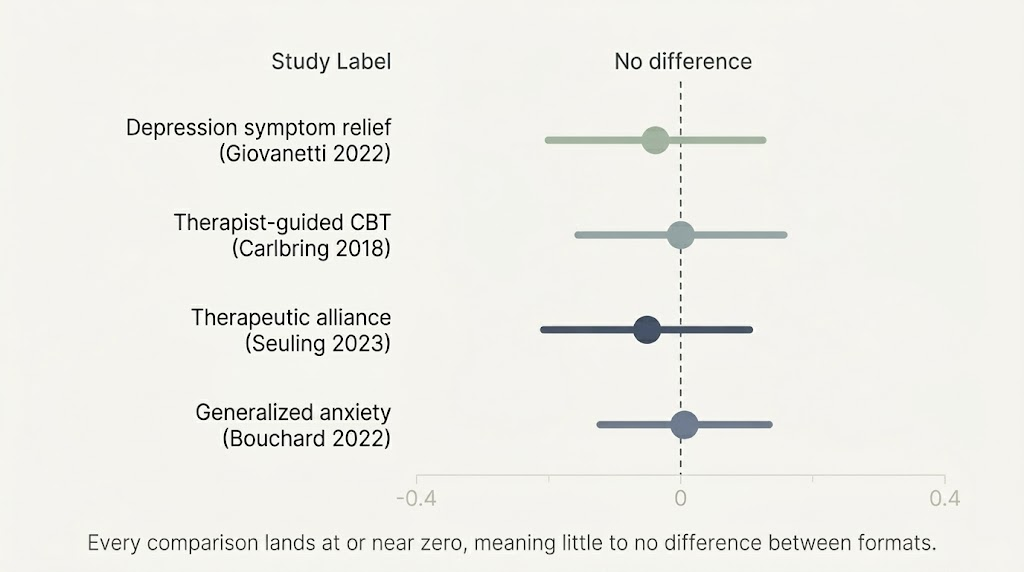
You deserve more than “studies show.” Here are the specifics.
Depression
Depression is common. The CDC’s National Center for Health Statistics found that about 13% of Americans age 12 and older had depression (moderate or greater symptoms) in a recent two-week window, and the rate was higher for adults ages 20 to 39, at about 17%. (NCHS Data Brief 527) If you’re in that group, you’re far from alone.
So does video therapy work for it? A 2022 meta-analysis in Telemedicine and e-Health pooled randomized trials that compared video therapy directly with in-person therapy for depression. The result: video therapy was roughly comparable in reducing depressive symptoms (an effect size of 0.04, which is about as close to “no difference” as research gets). People also stuck with it at about the same rate, so video clients weren’t quietly dropping out more often. (Giovanetti et al., 2022)
That matters, because depression can make everything feel like too much effort. If getting to an appointment is one more hurdle, learning that you’re not trading away results by staying home is good news. If you’re wondering whether what you’re feeling counts, our page on depression therapy walks through the signs, including the slow-burn kind that’s easy to write off as “just a rough season.”
Anxiety
For anxiety, the picture looks just as good. In a randomized trial of 148 adults with generalized anxiety, CBT delivered by videoconference was statistically non-inferior to the same treatment face to face. Both groups improved substantially, and dropout didn’t differ between them. (Bouchard et al., 2022)
A broader review adds some weight. A meta-analysis of 20 studies compared therapist-guided, internet-based CBT with face-to-face CBT across psychiatric and physical health conditions. Overall outcomes were essentially the same. (Carlbring et al., 2018) A fair caveat: those studies are about guided online programs, a close cousin of video sessions rather than the same thing. Still, the direction of the evidence is consistent.
If racing thoughts, panic, or that constant low hum of dread sounds familiar, our anxiety therapy page explains how we work with it, and our blog post on online therapy for anxiety in California is a more casual read if you want to feel less alone first.
The part everyone worries about: the human connection
“Can I really open up to someone through a screen?” is the objection we hear most. The research is reassuring here too. A 2023 meta-analysis of 18 publications found no significant difference in therapeutic alliance, meaning the bond and sense of teamwork between client and therapist, between video and in-person therapy. That held whether the client or the therapist did the rating. (Seuling et al., 2023)
In plain terms: feeling seen is possible through a camera. Many clients find it easier to open up from their own space, where they already feel safe and relaxed.
Being seen is what makes therapy work, and that doesn’t depend on which room you’re sitting in. Some of the most honest conversations I’ve had with clients happen when they’re on their own couch, in their own space, where they don’t have to perform. For me this work isn’t just professional, it’s personal. I know what it feels like to be stuck and unsure where to turn, and I want getting help to feel less like a hurdle and more like a relief.
Damian Robledo, MSW, LCSW, Founder & CEO, Core Therapy
What the studies can’t tell us
Being straight with you matters more than sounding impressive. Most of this research looks at CBT-style approaches. Many trials screen out people in acute crisis or with very severe symptoms. And “as effective on average” doesn’t promise it will be right for you. Some people simply prefer being in a room with another person, and that’s a legitimate reason to choose in-person care.
Online vs. in-person therapy at a glance
| Online (live video) | In person | |
| Symptom relief (depression, anxiety) | Comparable in head-to-head trials | Comparable in head-to-head trials |
| Therapeutic bond | No significant difference found | No significant difference found |
| Dropout rates | No significant difference found in depression trials | No significant difference found in depression trials |
| Convenience | No commute; evenings and weekends | Travel and waiting room time |
| Privacy | Depends on having a private space at home | Private office |
| Access | Any licensed therapist who serves your part of California | Limited to what’s nearby |
| Crisis or severe symptoms | May need a higher level of care | Often better suited |
Still weighing it? Talk it through with a real person.
You don’t need a diagnosis, a perfect explanation of what’s wrong, or a clear plan to reach out. In a free consultation, you can ask us anything about how online therapy works, what it would look like for your anxiety or depression, and whether we’re the right fit. No pressure, no commute, no waitlist.
Schedule My Free Consultation → · Prefer to call? (626) 618-5653
Why online therapy works well for real-life schedules
Effectiveness is the headline, but it isn’t the only thing that decides whether therapy happens. Consistency does. Therapy works when you keep showing up, and online sessions remove the usual reasons people don’t:
- No commute (because who wants to sit in traffic on the way to talking about their feelings?)
- Evening and weekend sessions, which we offer seven days a week
- Privacy, since there’s no waiting room and nobody sees you walk in
- Access, whether you’re in Los Angeles, Fresno, or somewhere a good therapist isn’t a short drive away
That last point is a big one in a state this size. The National Institute of Mental Health points to remote care as a way to reach people, including in areas where mental health professionals may not be physically available. (NIMH) Your therapist can be a great fit even if they’re hundreds of miles away.
What California clients should know before starting
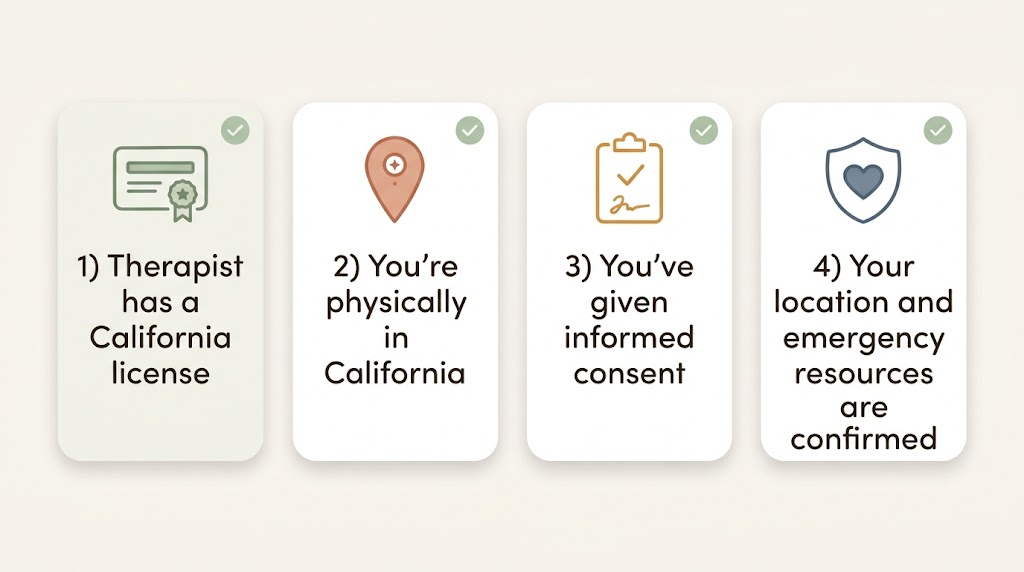
California has its own ground rules for online therapy. None of them are scary, but it helps to know what to expect.
Your therapist must be licensed in California. To see clients located in California, a therapist needs a current California license. Ask for your therapist’s license type and number. They’re required to share it. Our team includes LCSWs, LMFTs, LPCCs, psychologists, and associates.
You need to be in California during your session. Licensure is tied to where you’re sitting, not where you live. If you’re traveling out of state, let your therapist know before the session so you can plan around it.
Expect an informed consent conversation. Before telehealth begins, California therapists explain the benefits and limits of online care and get your consent. It’s a good moment to ask anything you’ve been wondering about privacy or technology.
Your therapist will ask where you are, every time. At the start of each session, they’ll confirm your location. It can feel repetitive, but it’s there so help can reach you quickly if something goes wrong. For the same reason, your therapist will also note local emergency resources for where you are.
(The California Board of Behavioral Sciences’telehealth FAQ lays out these requirements if you’d like the official version.)
Cost and coverage: Core Therapy accepts most major insurances, and you can verify your insurance before you book. We also offer lower-cost sliding-scale sessions with advanced graduate interns from the USC MSW program, supervised by licensed clinicians. Cost is one of the biggest reasons people put therapy off, so if money is the thing holding you back, ask us about it. That’s a normal first question.
Is online therapy right for you? A quick gut check
Online therapy tends to be a good fit if most of these sound like you:
- You’re dealing with everyday-but-exhausting anxiety, stress, low mood, or burnout, and you’re still managing to function
- You have a reasonably private spot and a stable internet connection
- Scheduling, travel, or energy are the things getting in your way
- You’d feel more comfortable opening up from your own space
- You want practical tools you can use between sessions
It may be worth considering in-person care, or extra support alongside therapy, if you’re in crisis, have no private space to talk, or your symptoms are severe or getting worse fast. More on that next.
When online therapy might not be enough
Online care isn’t the right fit for everyone, and a good therapist will tell you so. Consider a different level of care, or additional support, if:
- You’re having thoughts of harming yourself or someone else. Call or text 988, or call 911, right away rather than waiting for a session.
- You don’t have a private, safe place to talk. If privacy at home isn’t possible, tell your therapist. They can help you think through options, including whether in-person care would suit you better.
- Your symptoms are severe or getting worse fast. Some situations need in-person or more intensive support alongside therapy.
- You’ve tried online therapy and truly dislike it. That’s useful information, not a failure.
Struggling doesn’t mean you need to be in crisis to start. Most people who reach out are somewhere in the messy middle: functioning, but exhausted.
How to get the most out of online sessions
Small setup choices make a bigger difference than you’d think:
- Pick a spot you can close a door on. Headphones help if you share space.
- Test your connection beforehand, and ask your therapist for a backup plan (usually a phone call) if the video drops.
- Treat it like a real appointment. Same chair, same time, phone on silent.
- Keep a few notes. Jot down what hit you between sessions so you don’t lose it.
- Tell your therapist what’s working and what isn’t. Fit matters more than almost anything else. If it doesn’t feel right after a few sessions, say so.
Questions to ask before you book any online therapist
Whether you choose us or someone else, these questions help you find a good fit:
- Are you licensed in California, and what’s your license type and number?
- What approach do you use for anxiety or depression, and what does that look like session to session?
- What happens if my video drops or I’m in distress during a session?
- Do you take my insurance, and what will I pay out of pocket?
- How do we know if it’s working, and what if it isn’t?
A therapist who welcomes these questions is usually a good sign.
What your first session at Core Therapy looks like
Our approach to individual therapy is built to feel human, not stuffy. Think casual conversation, a therapist who gets to know you, and practical tools you can use between sessions. You don’t need a diagnosis to start, and you don’t have to talk about everything on day one. You can talk, stay quiet, cry, or just breathe. Sessions are 100% virtual and available seven days a week.
Here’s how getting started works:
- Book a free consultation. Tell us what’s going on, in as much or as little detail as you like.
- Get matched. We’ll help you find the therapist who’s right for you.
- Show up from wherever feels comfortable, as long as you’re in California. That’s it.
Many clients notice small shifts within the first few sessions. Deeper change takes longer, and that’s normal.
Ready to feel more like yourself?
Anxiety and depression are treatable, and you don’t have to wait until things get worse to get support. Start with a free consultation, and we’ll take it from there.
Book My Free Consultation → ·Check My Insurance → · (626) 618-5653
Frequently asked questions
Is online therapy as good as in-person therapy for anxiety?
For most adults, research suggests yes. A randomized trial of adults with generalized anxiety found video-delivered CBT was non-inferior to in-person CBT, with similar improvement and similar dropout. Individual results vary, and some people prefer in-person sessions.
Can online therapy help with depression?
Yes. A 2022 meta-analysis of randomized trials found video therapy and in-person therapy produced roughly comparable reductions in depressive symptoms. If you’re in crisis or having thoughts of suicide, call or text 988 rather than waiting for a session.
Do I have to be in California to do online therapy with a California therapist?
Yes. Your therapist’s California license covers clients who are physically located in California during the session. If you’ll be traveling, tell your therapist ahead of time.
Is online therapy private and secure?
It should be. Ask your therapist what platform they use and how your information is protected, and take your own steps at home: a private room, a secure Wi-Fi network, and headphones.
Does insurance cover online therapy in California?
Many plans do. Core Therapy accepts most major insurances, and you can verify your insurance before booking. Sliding-scale options are also available.
Do I need a diagnosis to start online therapy?
No. You don’t need a diagnosis, and you don’t need to be in crisis. If anxiety, low mood, or stress is getting in the way of your life, that’s reason enough to reach out.
How long does it take for online therapy to work?
It varies. Many clients notice small changes within a few sessions, while deeper patterns take longer. Your therapist should check in with you regularly about progress and adjust the plan if something isn’t helping.
About this article: Written by the Core Therapy team and clinically reviewed by Damian Robledo, MSW, LCSW, founder of Core Therapy. Damian started Core Therapy in 2022 to make quality mental health care easier to reach across California. Learn more about our team.
Disclaimer: This article is for general education and isn’t a substitute for professional mental health advice, diagnosis, or treatment. Reading it doesn’t create a therapist-client relationship. Always talk with a licensed provider about which level of care is right for you.
If you need help right now:
- Call or text 988 (Suicide & Crisis Lifeline), 24/7
- Text HOME to 741741 (Crisis Text Line)
- Call 911 or go to your nearest emergency room if you’re in immediate danger
Sources
- Brody DJ, Hughes JP. Depression Prevalence in Adolescents and Adults: United States, August 2021 to August 2023. NCHS Data Brief No. 527, 2025.
- Giovanetti AK, Punt SEW, Nelson EL, Ilardi SS. Teletherapy Versus In-Person Psychotherapy for Depression: A Meta-Analysis of Randomized Controlled Trials. Telemedicine and e-Health, 2022.
- Bouchard S, et al. A Multisite Non-Inferiority Randomized Controlled Trial of the Efficacy of Cognitive-Behavior Therapy for Generalized Anxiety Disorder Delivered by Videoconference. Journal of Clinical Medicine, 2022.
- Carlbring P, et al. Internet-based vs. face-to-face cognitive behavior therapy for psychiatric and somatic disorders: an updated systematic review and meta-analysis. Cognitive Behaviour Therapy, 2018.
- Seuling PD, et al. Therapeutic alliance in videoconferencing psychotherapy compared to psychotherapy in person: A systematic review and meta-analysis. Journal of Telemedicine and Telecare, 2023/2024.
- National Institute of Mental Health. Psychotherapies.
- California Board of Behavioral Sciences. Telehealth FAQ.